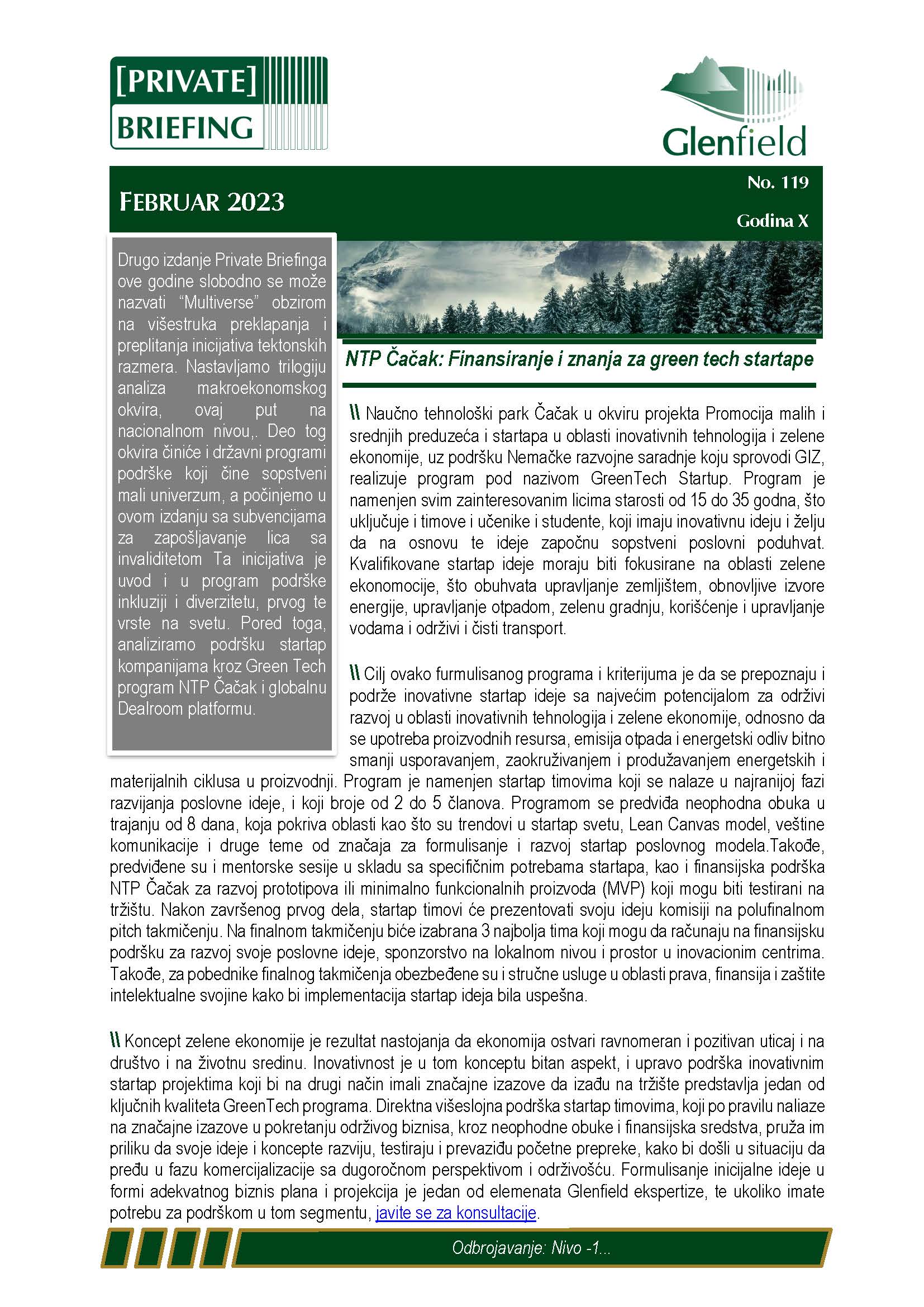
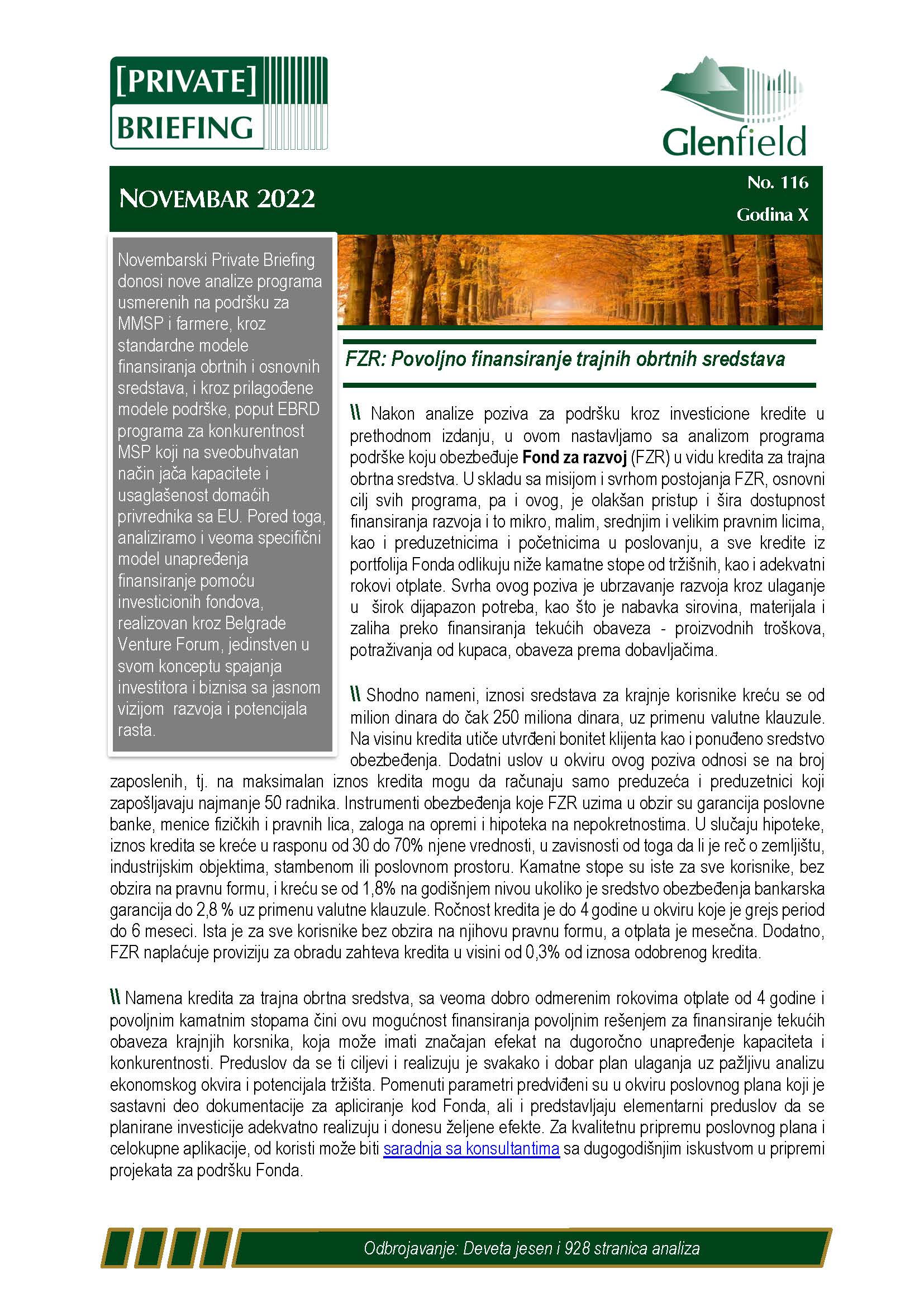
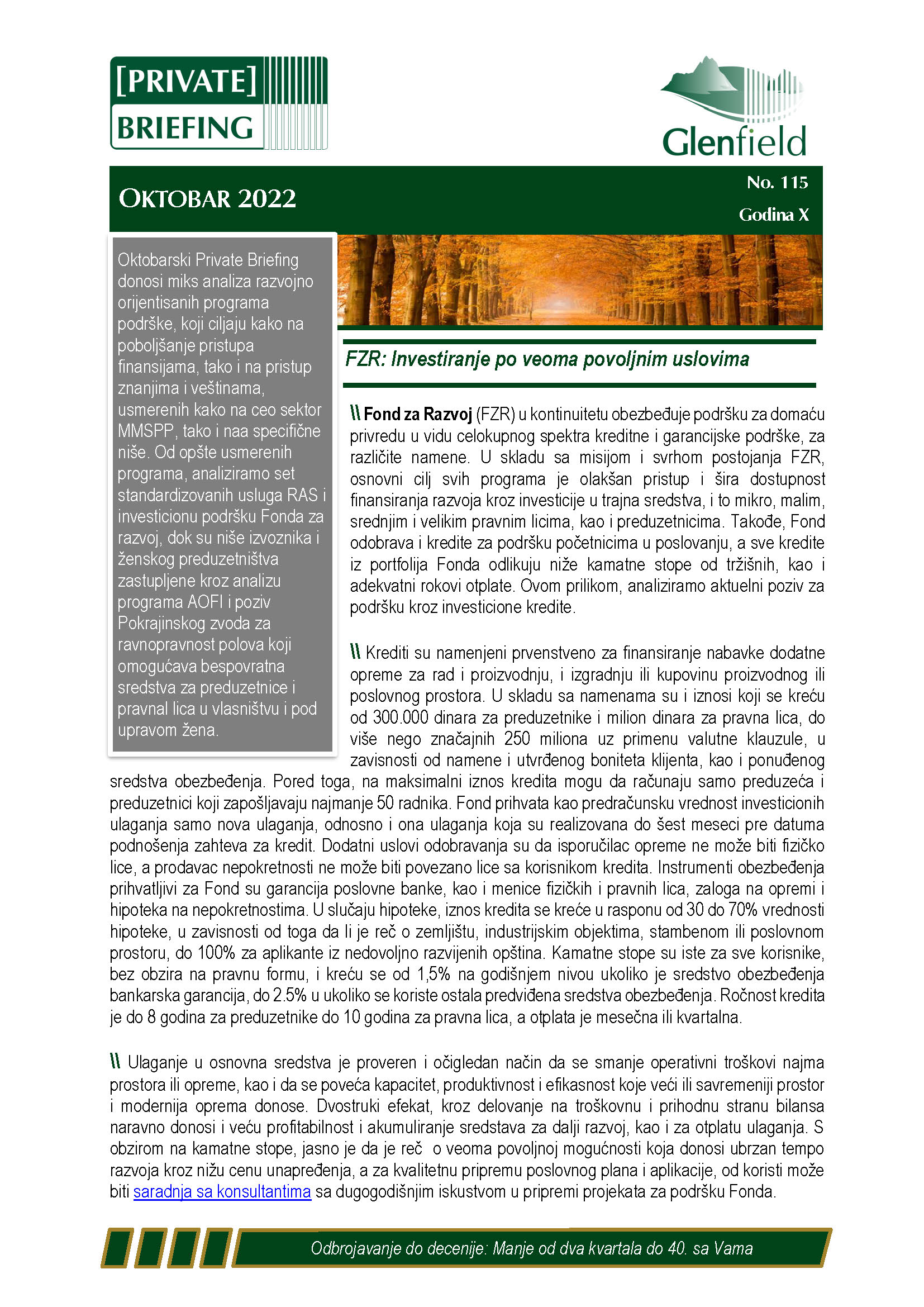
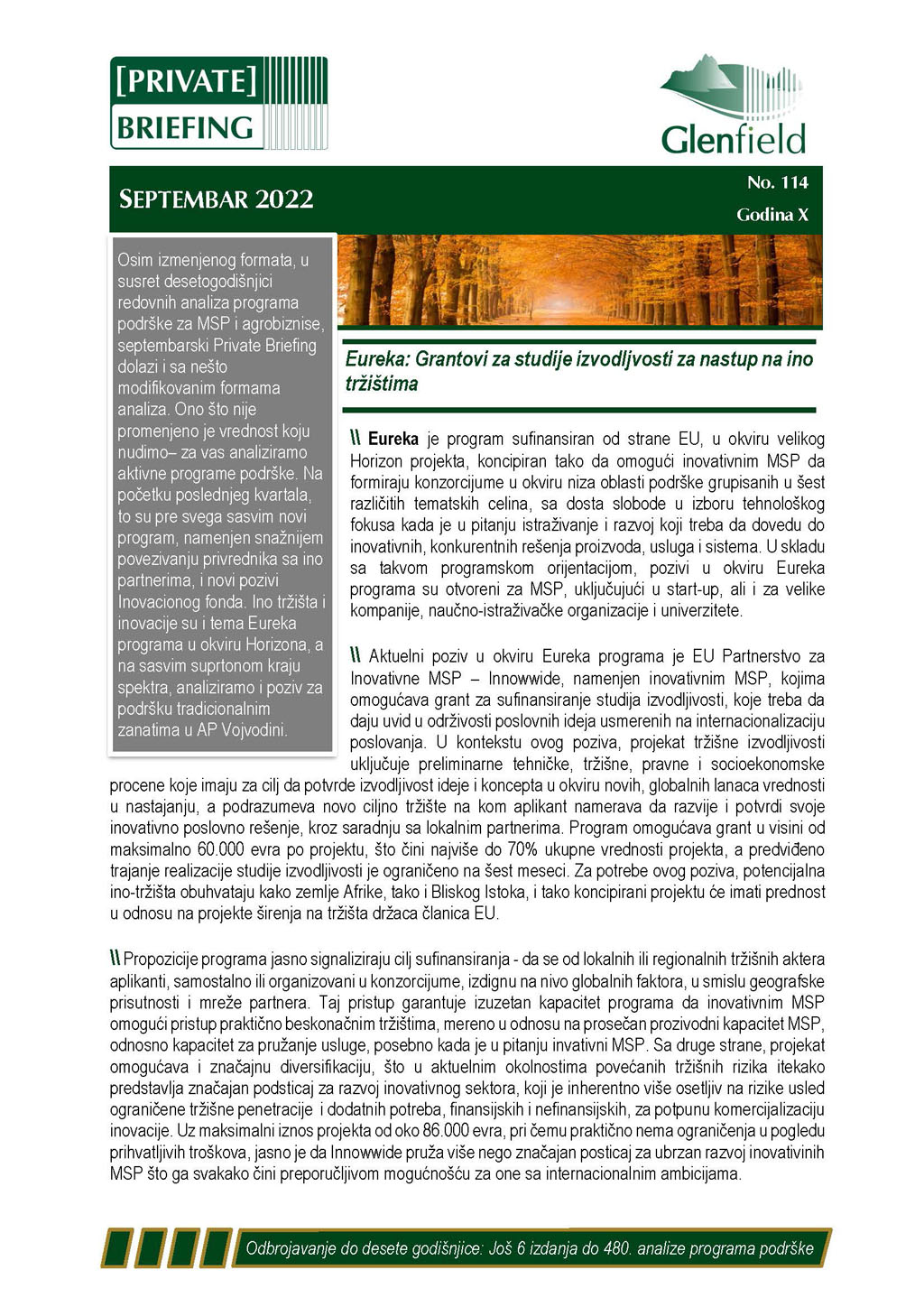
The September Private Briefing concludes the Summer Trilogy on Hydration, although liquidity remains in focus after the summer has passed. We open the issue with the sixth cycle of the Innovation Fund’s Smart Start programme, which fills the funding gap between an idea and the first prototype, at a stage when banks and investors are generally absent. In the third episode of the trilogy, we turn to external financing, borrowing, refinancing and bank relationship management. This is followed by two concrete examples, the Ministry of Economy’s subsidised Capital for Development loan programme, now extended to permanent working capital, and the Development Fund of Vojvodina’s loans for permanent working capital, with maturities and pricing tailored to that purpose.
// The Innovation Fund (IF) has opened the sixth cycle of its Smart Start programme for teams of two to five members who want to turn a business idea into a first prototype or minimum viable product (MVP). The eligibility requirements remain the same as in previous calls, meaning that at least 51% of team members must be residents of Serbia, while at least the same proportion must have no ownership stakes in other companies in the country. The Fund provides up to 5.400.000 dinars per project, or up to 90% of the total budget, while applicants must contribute at least 10% in cash from private sources independent of the Fund. Contributions in kind are not eligible.
// In addition to development funding, each approved project receives a further 600.000 dinars reserved exclusively for mentoring and separate from its operating budget. Projects are expected to last between six and nine months. Before signing the funding agreement, teams must establish a limited liability company in which at least 51% of the proposed team members are founders and together own 100% of the shares, while the legal representative must be one of those founders. In a team of two, both members must be founders, in a team of three, at least two, and in a team of four or five, at least three. To ensure focus and continuity of development, each team member may take part in only one application and work on only one Fund project at any given time. IF directs at least 50% of the available budget towards the priority areas of the Smart Specialisation Strategy, namely food for the future, information and communication technologies with a focus on artificial intelligence, machines and production processes of the future, and creative industries, provided there are enough applications of sufficient quality. The application, including a video presentation of up to three minutes, must be submitted entirely in English for the international evaluation process. Evaluation considers the perceived usefulness and competitive advantage of the proposed solution, its market potential and the competence of the team.
// Teams at this stage of development usually have a defined idea but lack the funds to take it to the point where it can be assessed, through a first prototype or MVP that can be tested in the market or presented to a potential investor. Banks, and most private investors, are generally absent at this stage because the team has neither revenue nor evidence from the market on which they can base a decision. Smart Start fills this specific, tangible gap in the financing chain with an amount designed to cover a significant share of expected costs over two or three quarters of this critical development phase. Alongside the operating budget, mentoring helps the team turn its idea into a structured business model, with a defined target group, routes to market and revenue assumptions, elements that teams at this stage often have yet to develop fully. Over five previous cycles, the programme has established itself as an entry point into IF’s wider system of support, which continues through instruments for further company growth such as Mini Grants, Co-Fund and Collab. In this context, a team that successfully completes Smart Start leaves the programme with a first prototype and a solid starting point for the subsequent stages of financing available as the company grows.
Summer Hydration Trilogy E3: External Infusion
// In the first episode of the trilogy, we diagnosed illiquidity through its most visible symptom, the blocking of bank accounts. In the second, we examined internal circulation, the financial management that enables a company to see in advance where its money is and when it will arrive, and to manage its own hydration. The third episode turns to another course of treatment, whether preventive or remedial, through external instruments, borrowing, refinancing and bank relationship management. Like any infusion, these work best when we know precisely what needs to be replenished and by how much.
// At first sight, the primary question about financing seems to be where it can be obtained, or whether it is available at all. Although access is subject to constraints, the market offers numerous commercial sources and a broad range of financial instruments and models. There are also many blended products developed with the support of the state or development funds. To varying degrees, these offset the limitations of commercial sources, and we regularly analyse them in Private Briefing.
The real question, then, is which instrument suits which need. A revolving credit line or an overdraft covers short term fluctuations when a payment is delayed but expected within a predictable period. Refinancing makes sense when a company has several loans with different maturities and costs, and consolidating them into a single facility on better terms creates room in its monthly debt servicing. Factoring, which is not a loan, addresses the problem we saw in APR data, where businesses hold around two dinars in receivables from customers for every dinar in their bank accounts. Investment loans, including the development credit lines we regularly cover in Private Briefing,
serve a different purpose and are the wrong answer to a working capital gap, just as a short term credit line is the wrong way to finance equipment. When deciding whether to lend and how to price a facility, a bank assesses both the financial statements and the quality of the information a company can provide about itself. An up to date financial profile, with a clear strategy and an explanation of the financial model, directly affects whether the bank treats an application as a standard facility or as an exposure requiring additional security and a higher price. A client who approaches a bank with a clear purpose, amount, term and source of repayment is in a very different position from one seeking funds after a problem has already arisen.
This is where Banking Relationship Management (BRM) comes in. Decades of work with banks and development institutions on lending, underwriting and portfolio management have led us to a premise that guides our practice: access to finance depends in part on understanding the lending process. We apply that premise both in large scale training for small businesses under numerous access to finance initiatives and in tailored work with individual larger businesses. We define the actual need and the most suitable instrument, prepare the loan application, business plan and projections, gather and compare offers from several banks, and represent the client in negotiations over interest rates, fees, collateral and contractual terms. After approval, we monitor compliance with contractual obligations and regular reporting to the bank, so that the next application is planned and ready well before the funds are needed, when financing can also be obtained on the most favourable terms.
The infusion thus brings the trilogy full circle. The blocking of a bank account is the endpoint of a process that internal circulation can arrest, while external instruments build on that work rather than replace it. CFO outsourcing, or external financial management, and its light finance variant ensure that a company knows how much money it needs, when and why, and obtains it on the right terms, from the right bank and in the right form. Together, these two functions turn business hydration from a seasonal metaphor into a lasting system. Glenfield consultants are available to assess an existing financing structure and prepare for discussions with a bank as the year’s financial race enters its final stretch.
Ministry of Economy: Subsidised Capital for Development
// The Ministry of Economy, in cooperation with the Development Agency of Serbia (SDA) and Banka Poštanska štedionica, has opened a call for grants under the Capital for Development subsidised loan programme for equipment and working capital. Its total budget of 220 million dinars is intended to subsidise interest rates. Eligible applicants are companies and cooperatives classified as micro or small legal entities in their 2025 financial statements, as well as entrepreneurs registered with the Serbian Business Registers Agency. The programme continues the earlier and most popular model of support for financing fixed assets through banks and leasing companies. The range of finance providers has now narrowed, but support that was previously available only for equipment has been extended to permanent working capital. The programme’s purpose thus explicitly expands beyond investment to include sustained support for borrowers’ liquidity.
For the purchase of new equipment, the total credit line amounts to 1 billion dinars, with individual loans ranging from 700.000 to 15 million dinars and a required borrower contribution of at least 30% of the investment value. The fixed nominal interest rate is 6,3% a year on a dinar loan without a foreign currency clause. The borrower pays only 2%, while the Ministry subsidises the remaining 4,3%. Repayment may extend to 60 months, including a six month grace period, while commission and application processing fees of up to 0,5% are also covered by the subsidy. The required security consists of a company promissory note, a personal promissory note from any owner holding more than 25% of the company, and a pledge over the equipment purchased.
For permanent working capital, the credit line also amounts to 1 billion dinars, with individual loans of up to 15 million dinars. The nominal annual interest rate is 6,7%, with the cost divided on the same principle: the borrower pays 2%, while the Ministry subsidises 4,7%. Repayment, including a six month grace period, is limited to 36 months, considerably shorter than for equipment loans, in line with the shorter term nature of working capital needs. Security includes a company promissory note and a personal promissory note from the owner. For loans above 2,5 million dinars to entrepreneurs and micro legal entities, or above 6 million dinars to small legal entities, a first ranking mortgage or a pledge over equipment or vehicles is also required.
Both loans have terms that depart from usual practice in some respects. A ban on distributing profits until the loan has been repaid, a common condition of development credit lines, does not apply here. Early repayment is permitted without penalty, and the bank may not impose conditions on programme borrowers that are stricter than those applying to its other clients, such as a minimum volume of payment transactions. Applications are submitted at a bank branch together with the loan request and supporting documents, simplifying the process. Applicants may also apply for each of the two types of loan, combining investment in fixed assets with liquidity support through the same programme and on terms that differ only slightly.
The effective interest rate paid by borrowers on both types of loan is substantially below the average market rate at which businesses currently borrow. At the end of 2025, the average interest rate on dinar loans to businesses stood at 6,5%. In practice, the subsidy therefore reduces the cost of financing to about a third of that level. For micro and small businesses admitted to the programme, this can be a significant and attainable incentive, particularly given the well-measured collateral requirements. The budget of 220 million dinars for subsidies, alongside credit lines of 1 billion dinars for each purpose, suggests capacity for several hundred approved loans, depending on how close the average application is to the lower or upper end of the available range. Extending the programme from equipment to working capital also brings in businesses that need room to maintain financial stability, rather than funding for an investment cycle alone. Capital for Development is consequently a broader entry point into the system of state support than the earlier version of the programme, particularly as applicants can seek loans for both purposes at the same time.
RFV: Long Term Loans for Permanent Working Capital
// The Development Fund of the Autonomous Province of Vojvodina (RFV) has opened a call for long term loans for permanent working capital, intended to support continuity in borrowers’ operations and encourage new employment. Legal entities and entrepreneurs in the micro, small or medium size categories may apply if their registered office is in the Autonomous Province of Vojvodina. Loans range from 500.000 to 50.000.000 dinars, depending on the applicant’s creditworthiness.
The Fund offers two interest rate models. Loans with a foreign currency clause carry a variable rate of 2% plus six month EURIBOR. The NBS middle exchange rate for the euro applies, with adjustments every six months, while the rate is reduced by a further 1% when the loan is secured by a commercial bank guarantee. Dinar loans also carry a variable rate, set at the NBS reference rate plus 0,50% for applicants based in cities and municipalities in the third and fourth development groups, or plus 0,80% for those in the first and second groups. Repayment may extend to 48 months, including a grace period of up to six months. Instalments are paid monthly or quarterly, with six monthly payments available only to borrowers in agriculture. As security, the Fund requires promissory notes from the borrower and personal promissory notes from the owner, founder or director, except where a legal entity is not majority privately owned or
the loan is already secured by a commercial bank guarantee. For loans above 20 million dinars, a commercial bank guarantee is required, although a first ranking mortgage is accepted as an alternative. If the mortgage is over agricultural land, its appraised value must be at least 150% of the requested loan. For construction land or residential or commercial property, the required ratio is 200%. Applicants without a commercial bank guarantee must also provide at least two annual financial statements showing operating and net profit, as well as positive total equity in the previous year’s closing accounts. Entrepreneurs keeping simple accounts need only demonstrate that they operate at a net profit.
// Unlike seasonal or operating working capital, permanent working capital is not recovered within a short cycle. It remains tied up in inventory, receivables or ongoing operations for a longer period, so a term of up to 48 months, with a grace period of up to six months, gives a company time to service this structural need from its regular operations instead of continually renewing short term facilities at prevailing market rates. The relatively broad security options, with a mortgage or commercial bank guarantee as an alternative to personal promissory notes, also improve access for companies without substantial fixed collateral but with stable financial statements and consistently profitable operations. The choice between a foreign currency clause and a dinar loan, together with the possibility of a further interest rate reduction backed by a bank guarantee, allows applicants to match the loan structure to their exposure to exchange rate risk and the collateral available to them, rather than having to follow a single model set by the Fund. The different interest rates for municipalities in different development groups also show that, although the Fund lends on market principles, it continues to reflect regional policy in the cost of borrowing through a modest discount for businesses in less developed areas. In the context of the external liquidity instruments discussed in this issue’s third episode of the Summer Trilogy on Hydration, this call provides a concrete example of a credit line intended exclusively for permanent working capital, with a term and price suited to that purpose rather than to a generic business loan.
The current issue, as well as previous issues of Private Briefing in PDF format, are available here.
For any additional information or questions, feel free to contact us. Share your impressions, send us relevant news or let us know how your current projects are progressing.
Disclaimer: This report has been prepared and published under the authority of Glenfield Training and Consulting Doo and is intended for information purposes only. The information used has been obtained from sources considered reliable by Glenfield Training and Consulting Doo, but its accuracy and completeness are not guaranteed. No information or suggestion may be interpreted as an offer or solicitation to buy or sell. No part of this document may be reproduced without the written permission of Glenfield Training and Consulting.