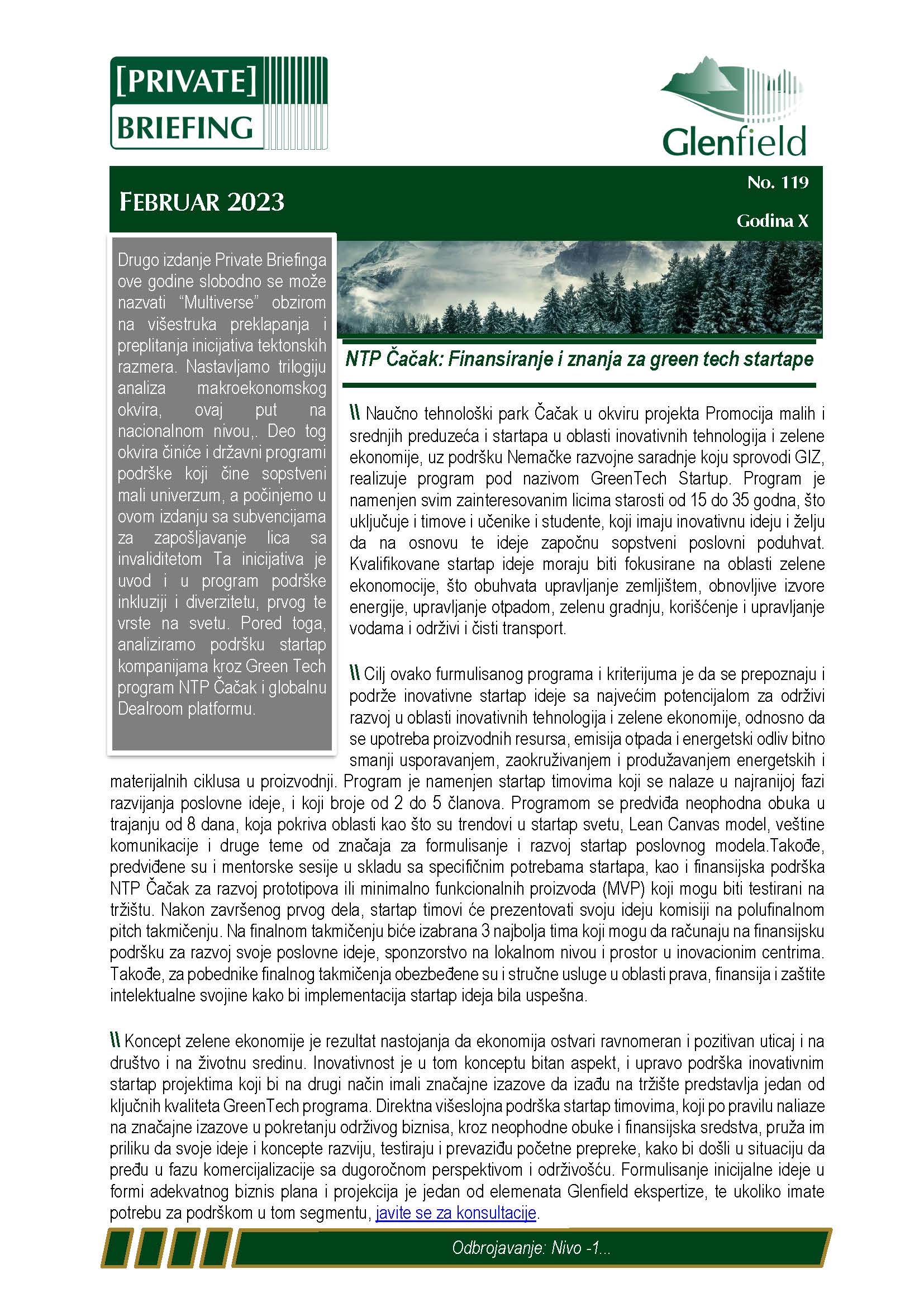
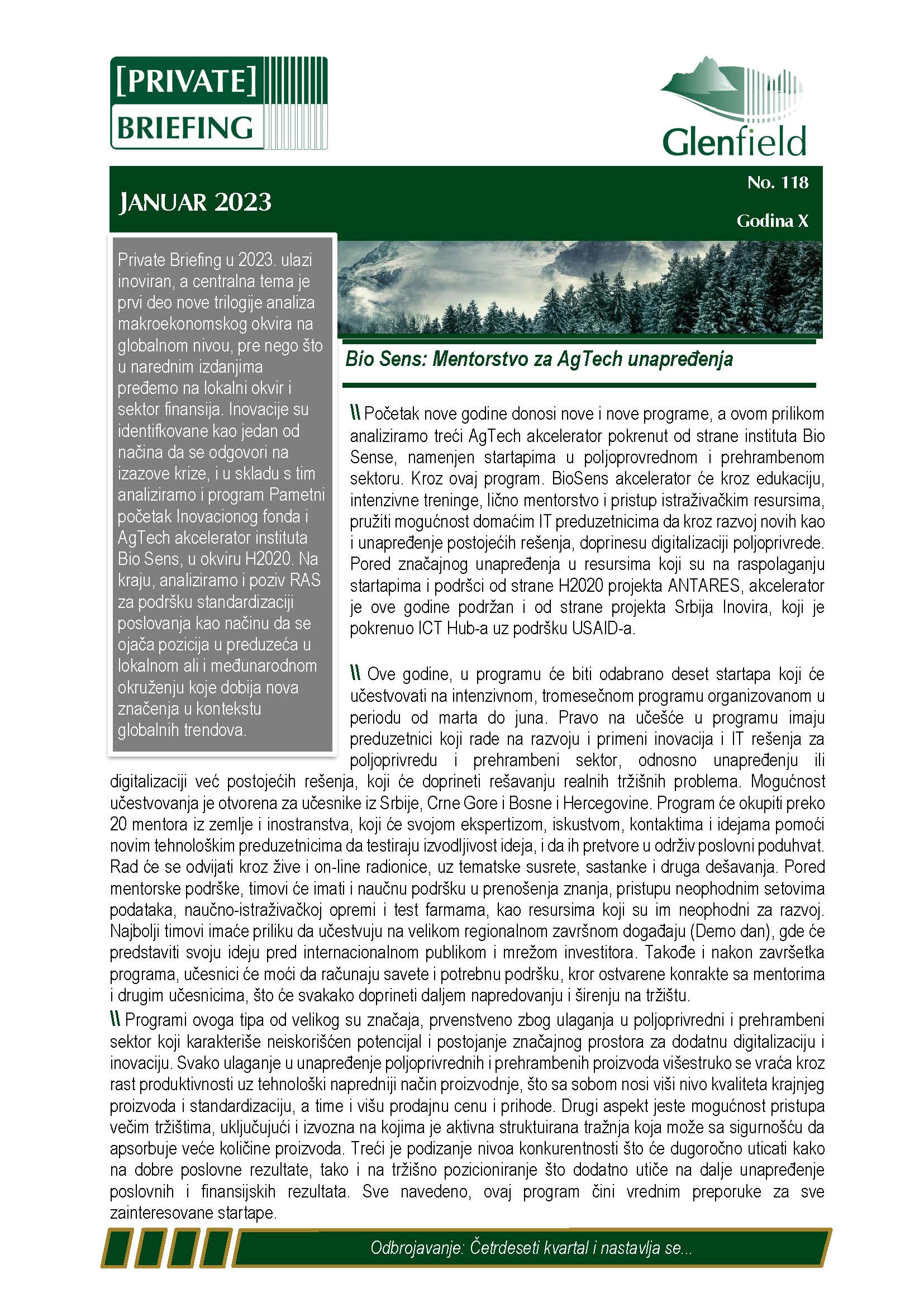
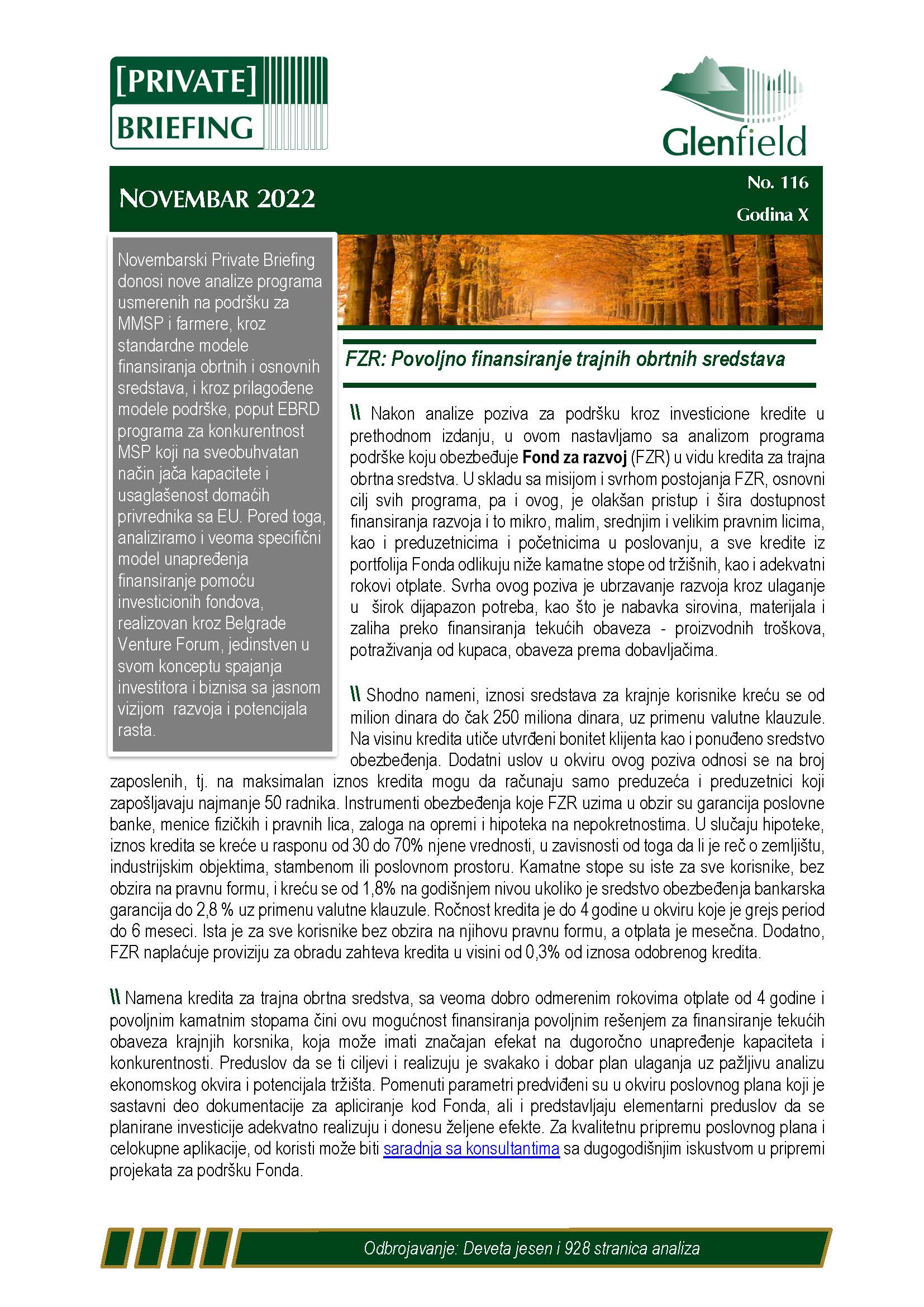
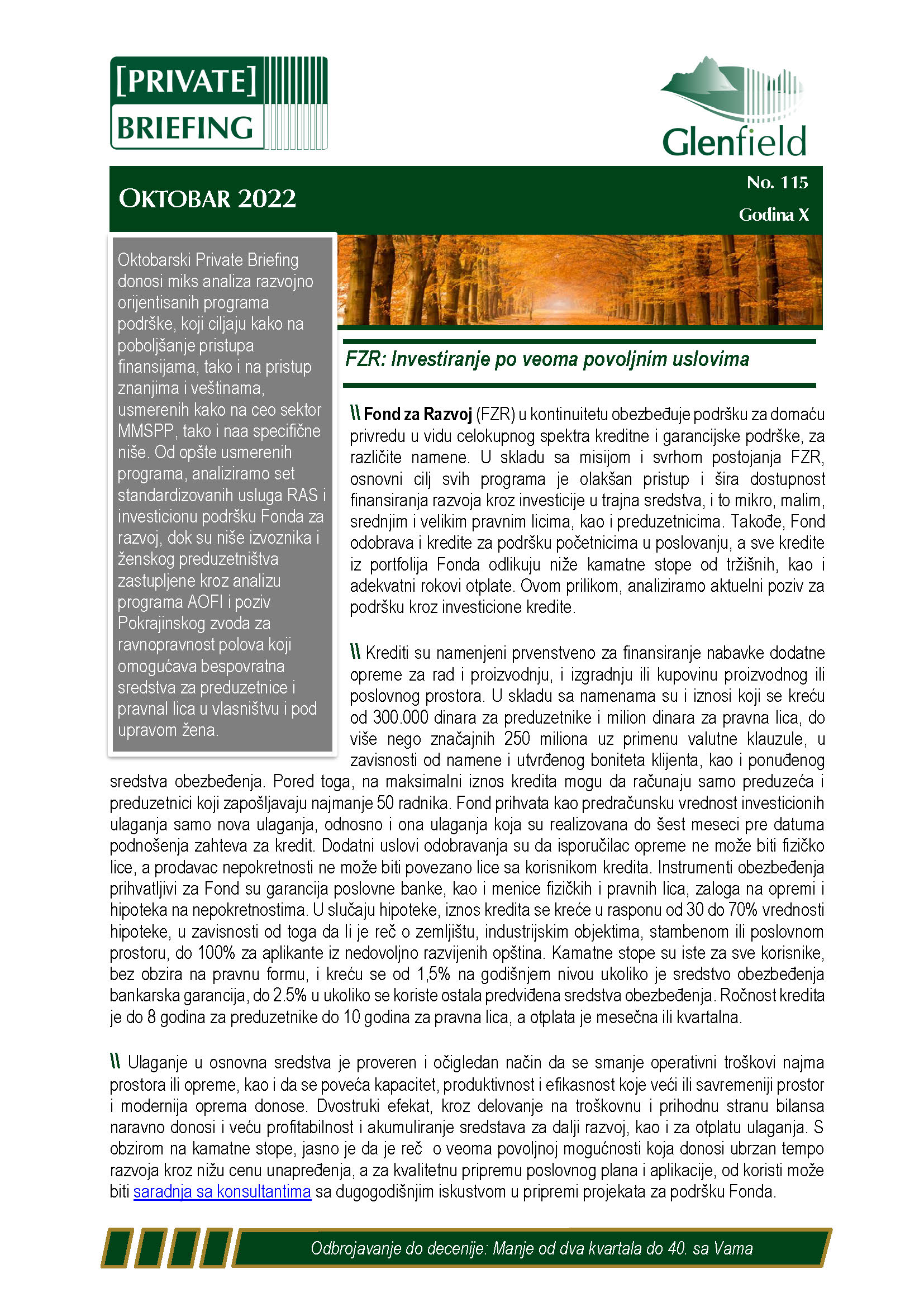
The July Private Briefing opens with an analysis of a CCIS programme offering SMEs free expert support for decarbonisation, from energy audits and carbon footprint calculations to financial planning and possible support for equipment and software. In the second episode of the Summer Hydration Trilogy, we move from diagnosing illiquidity to initial treatment, beginning with internal and preventive measures: financial management, cash flow planning and capacities that allow a company to identify and resolve a problem while prevention is still possible. We continue with an analysis of RFV loans for climate sustainability investments, and close the issue with DAP incentives for cows used to rear calves for fattening, a measure supporting the production base of domestic cattle farming.
// The Chamber of Commerce and Industry of Serbia (CCIS), under the Green Economy in Serbia project supported by German Development Cooperation and implemented by GIZ, has launched a free Advisory Programme for SME Decarbonisation. The programme is intended for manufacturing MSMEs that export to the EU market, are preparing to export, or supply exporters. The call is designed as carefully structured support for companies that will encounter requirements concerning emissions, energy consumption, resource use and supply chain sustainability through their relations with EU customers and partners.
// Companies choose one of four advisory services, depending on which part of their operations they first need to assess and improve. Support in circular economy and greenhouse gas emissions management is available to 40 companies and covers resource efficiency, potential for industrial symbiosis and nonfinancial accounting. Corporate carbon footprint calculations under the GHG Protocol are planned for 25 companies, while another 25 may receive an energy audit to identify measures that reduce energy consumption and costs. The fourth service, intended for ten companies, is financial mentoring for developing a business strategy and financial plan to introduce a green business model. It includes a diagnostic analysis, work with a certified mentor, site visits and recommendations linking investment plans with liquidity, indebtedness and the company’s actual repayment capacity. Consultants will work with selected companies from September until the end of October, and the process concludes with a report proposing measures for implementation. Six to eight months after accepting the report, participants will document progress through a case study. An important addition is the opportunity for companies that successfully complete the advisory process to apply for subsequent GIZ support to purchase new equipment or software. A total of EUR 300.000 is available for this phase, while an individual grant may not exceed EUR 10.000, with a mandatory own contribution of at least 50% of the total project value excluding VAT. The grant is paid by reimbursement, and only costs incurred during the contracted period and related to the approved project are eligible.
// The practical value of the call lies not only in the free energy audit, emissions calculation or consultancy advice, but also in the sequence of support. The process first identifies where losses, emissions and financial constraints arise, then defines measures and an implementation plan, and only afterwards opens the possibility of investing in equipment or software. This structure reduces the risk of a green investment becoming an isolated purchase with no clear effect on costs, compliance with customer requirements or competitiveness. For manufacturing SMEs operating towards the EU market, the programme therefore provides an exceptionally well structured starting framework for turning decarbonisation from regulatory pressure into a measurable and financially sustainable development process, and fully deserves recommendation.
Summer Hydration Trilogy E2: Internal Circulation
// In the first episode, we analysed the consequence, blocked accounts. In the second, we change perspective and, instead of asking what happens when there is no money left, consider what can be done while a company is still operating, selling, invoicing and working at full capacity. This is when liquidity management has its full meaning, as prevention and as the ability to see in advance where the money is, when it will arrive and which obligations it must cover.
The importance of continuous liquidity management is illustrated by the Serbian Business Registers Agency data for 2025. The domestic economy recorded a positive net result, but its current ratio was only 1.08 and its quick ratio, excluding inventories, fell to 0.70. Current assets therefore only just cover short term liabilities, while available funds and receivables would not be enough to settle them fully without selling inventories. The problem is not necessarily a lack of assets or income, but that those assets are not in a form from which obligations can be paid when due. The structure of current assets tells a similar story: of a total RSD 11.632 billion, RSD 4.063 billion was held in inventories, RSD 3.374 billion in trade receivables, and only RSD 1.691 billion in cash. For every dinar in the account, the economy held around 2.4 dinars in inventories and another two in the hands of customers, awaiting collection.
This shows that business growth can simultaneously increase income and intensify liquidity pressure, when inventories grow faster than they are sold and receivables faster than they are collected. The purpose of liquidity management, and financial management in general, is most visible in this context. While accounting records what has happened, financial management must show what follows. This includes cash flow projections, planning inflow and outflow scenarios, monitoring collection and payment periods, controlling inventories and identifying periods in which a cash shortage will arise. Once such an overview is established and regularly updated, management can act while it still has options, by accelerating collection, slowing procurement, changing the pace of an investment, negotiating terms or preparing adequate external financing in time. The gap between the need and available capacity is most visible among micro and small companies, which in 2025 had a current ratio of 0.67 and a quick ratio of 0.46.
A large company may keep liquidity low because it has a finance team, access to credit lines and negotiating power with customers and suppliers. A micro company is usually run by an owner who also manages sales, operations, employees and finance. The problem is not only a lack of money, but also a lack of time, tools and a management overview showing that it is approaching. This is why financial management, or the role of a finance director, should not be reserved for medium sized companies and large systems. Every company needs someone to connect the balance sheet, cash flow, working capital and business decisions into one management framework. External support, commonly called CFO outsourcing, brings that capacity through regular planning, analysis, reporting and management support. For companies that do not yet need that level of service, Glenfield offers a lighter version, a basic system of financial oversight, liquidity planning and monitoring of the most relevant indicators. The difference is in the intensity of support, not the principle.
// Sound financial management does not guarantee that a company will never need a loan, refinancing or another liquidity instrument. It does, however, change the timing and conditions under which such support is sought. A company that knows when it will lack cash, for how long and why can negotiate before the problem becomes an emergency. Instead of using financing as a final measure before its account is blocked, it can include it in a plan, align it with collection and use it to bridge a specific gap. This is the essence of internal business hydration. Money must circulate, but that circulation does not happen by itself. It is planned, monitored and adjusted. In the next episode, we move to the second stream of solutions, external instruments, lending, refinancing and banking relationship management, and explain why their value begins only when a company understands its own cash flows and knows exactly what it is trying to finance.
DFV: Long Term Loans for Climate Sustainable Investments
// The Development Fund of the Autonomous Province of Vojvodina, RFV, has announced a call for long term loans to finance climate sustainable investments, with the broader aim of reducing carbon dioxide emissions and mitigating global warming. Behind this goal is a specific investment framework, focused on projects that can reduce energy costs, modernise production and lessen dependence on fossil fuels. The call is relevant to companies and agricultural holdings that do not view the green transition as a separate environmental obligation, but as part of technological renewal and long term competitiveness. Eligible applicants include MSMEs and entrepreneurs based in Vojvodina, where the investment must also be implemented, as well as local government units, public enterprises, institutions and organisations, and active agricultural holdings.
Eligible purposes include improving the energy efficiency of production and business facilities, purchasing agricultural and other machinery with hybrid or electric drive, and purchasing attachments for integrated crop production. Eligible investments include direct seed drills and equipment for sowing in minimally cultivated soil, machines that perform cultivation in a single pass, geothermal pumps and other heating and cooling equipment.
The loan may also be used to purchase hybrid or electric vehicles, build solar power plants, biogas and biomass facilities, waste management systems and other investments that contribute to environmental protection. This broad scope allows the programme to be used both for individual equipment purchases and for more complex projects that change the way a company produces, consumes energy or manages resources.
Loans range from RSD 1 million to RSD 100 million, depending on the applicant’s creditworthiness. Funds may be used in a single amount or in tranches, in line with the pace of the investment. For legal entities, entrepreneurs and registered agricultural holdings, loans with a currency clause carry a variable interest rate of 2% plus six month EURIBOR. Where the loan is secured by a commercial bank guarantee, the interest rate is reduced by one percentage point. For dinar loans, legal entities and entrepreneurs from local government units in the third and fourth development groups pay the NBS reference rate plus 0.50%, while applicants from the first and second groups, as well as registered agricultural holdings, pay an additional 0.80%. The applicant’s own contribution must be at least 10% of the investment value, while investments made during the year before the application are also eligible. The repayment period is up to seven years, including a grace period of 12 months, or up to 24 months when the construction of a facility or other fixed asset capacity is financed. Repayment may fall due monthly, quarterly or every six months. For larger amounts, a commercial bank guarantee or first ranking mortgage is mandatory, while applicants not offering a bank guarantee must have positive equity and profit according to their latest annual accounts.
// The application must also include a business plan prepared using the Fund’s model, projected financial statements and documentation concerning the investment. The development value of this credit line lies in treating sustainable investment as a regular part of growth financing, rather than as a separate category available only to large systems. An amount of up to RSD 100 million, a repayment term of up to seven years and the possibility of drawing funds in stages create room for demanding projects, while the wide range of eligible purposes allows applicants to direct investment towards the actual source of consumption and emissions.
// The programme is particularly relevant because energy efficiency, own energy generation and equipment modernisation are increasingly matters of cost, regulatory compliance and market position at the same time. In that sense, this RFV loan does not finance only green equipment and transition, but also the effort to turn climate sustainability into a measurable business result. Highly favourable borrowing terms, a long repayment period and a grace period provide a strong incentive to reach those results while preserving liquidity and gradually improving overall operating capacity.
DAP: Incentives for Rearing Calves for Fattening
// The Directorate for Agrarian Payments, DAP, has announced the 2026 public call for livestock incentives for cows used to rear calves for fattening. This is direct support for the production base of the cattle sector, since the measure does not concern completed fattening or high quality breeding animals as a separate category, but cows that produce calves intended for further fattening. The support therefore has wider significance, as it encourages the preservation of the breeding herd and continuity of production in a part of the sector where results take several seasons to materialise.
Eligible applicants are legal entities, entrepreneurs and individuals who hold active commercial agricultural holdings. Support is available for cows that calved between 1 April 2025 and 31 March 2026. The incentive amounts to RSD 20,000 per animal, and an applicant may submit only one request during the call, which means that data on all eligible animals should be recorded before final submission.
The economic logic of the measure becomes clearer when the position of calf producers within the full chain is considered. Feed, veterinary care, reproduction and animal keeping costs arise continuously, while income is earned only when the calf reaches the appropriate age and weight for sale or continuation of production. The RSD 20,000 incentive therefore does not finance a new investment or change the basic economics of the holding, but it can ease part of the regular costs while the producer maintains production capacity before earning direct income. Its value rises with the number of eligible animals, but remains linked to actual calving, connecting the measure with active production rather than the formal ownership of livestock.
This scheme differs from incentives for high quality breeding animals, aimed at improving genetics and the long term quality of the herd, and from fattening incentives, which follow the final stage of production and the sale of animals. Support for cows used to rear calves for fattening lies between these two points and acts on the actual base from which future fattening production develops. It is therefore highly relevant to holdings committed to a stable, multiannual livestock cycle, which build income not only on individual sales but on maintaining a sufficient number of productive animals.
// The practical value of this call also lies in its regularity and simple, predictable structure. A fixed amount per eligible animal allows a holding to estimate the level of support in advance, while the clearly defined calving period links payment to previously completed production. The subsidy itself does not resolve productivity, market price or feed cost issues, but gives producers maintaining a breeding herd an additional incentive to continue production even where returns are slow and volatility in the price of the final product has an additional time dimension that increases uncertainty. In this sense, the measure is an important element of continuity for producers, as it supports the stage that forms a herd with enough calves to provide the base for sustainable fattening in future cycles.
The current issue, as well as previous issues of Private Briefing in PDF format, are available here.
For any additional information or questions, feel free to contact us. Share your impressions, send us relevant news or let us know how your current projects are progressing.
Disclaimer: This report has been prepared and published under the authority of Glenfield Training and Consulting Doo and is intended for information purposes only. The information used has been obtained from sources considered reliable by Glenfield Training and Consulting Doo, but its accuracy and completeness are not guaranteed. No information or suggestion may be interpreted as an offer or solicitation to buy or sell. No part of this document may be reproduced without the written permission of Glenfield Training and Consulting.