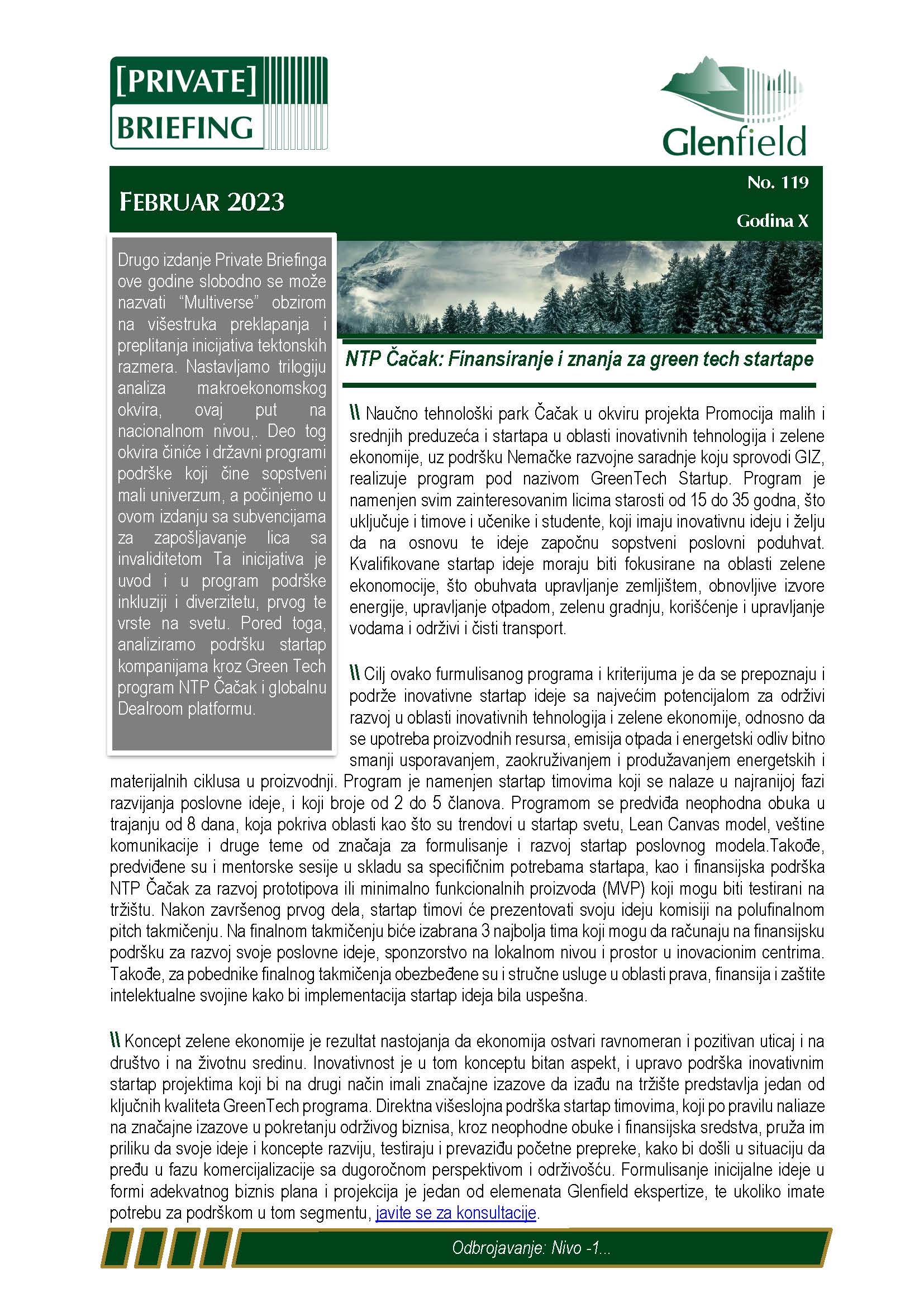
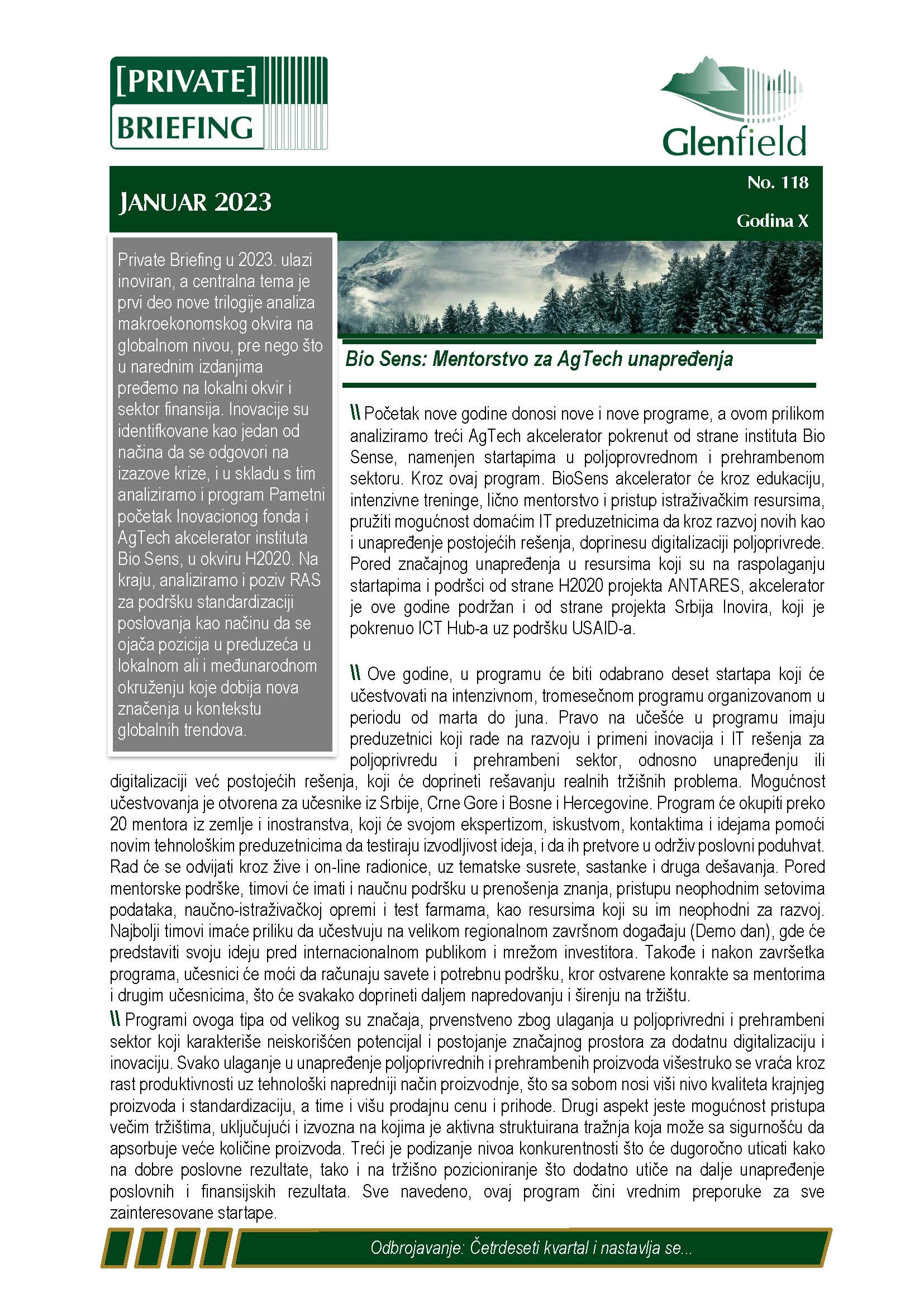
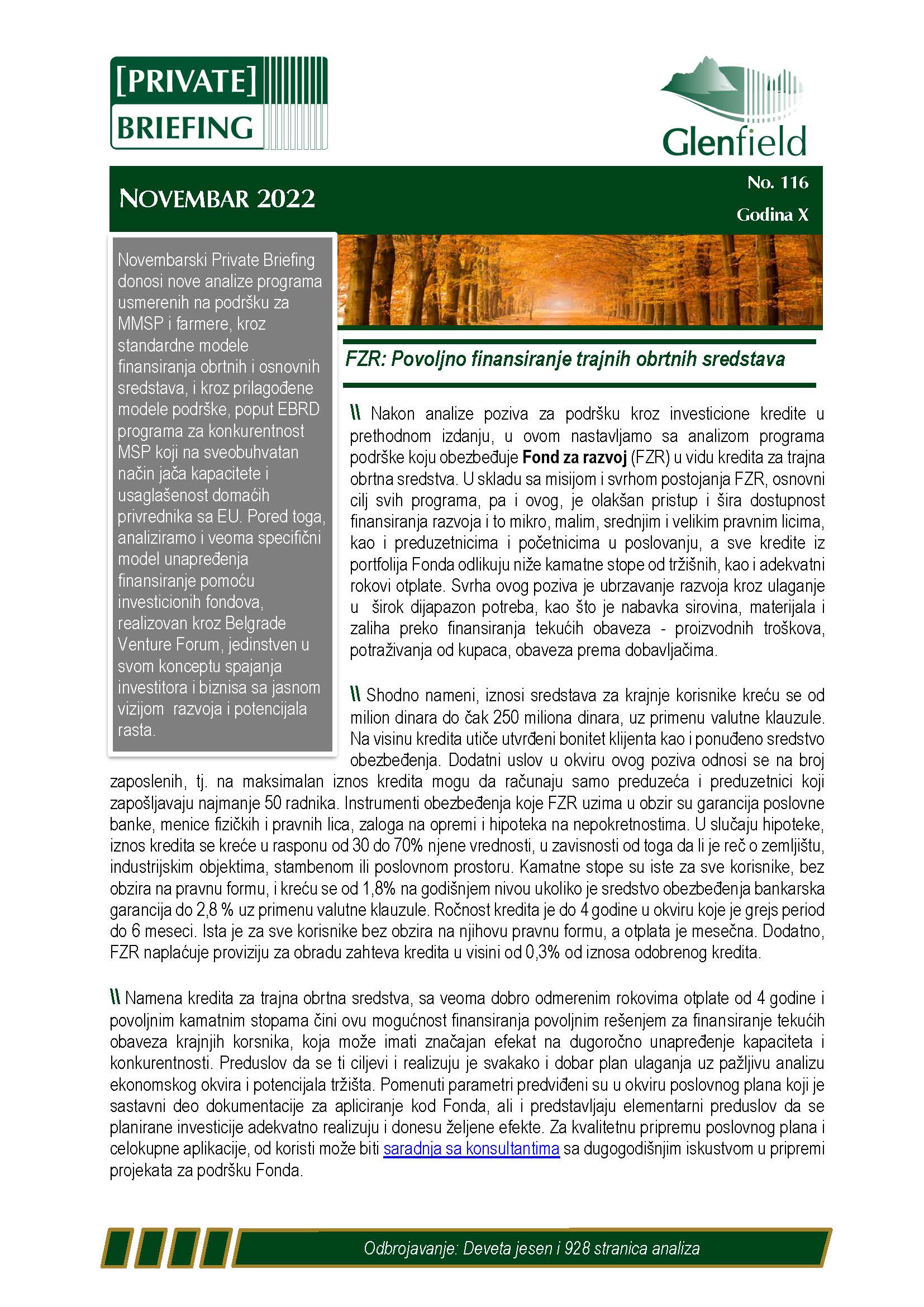
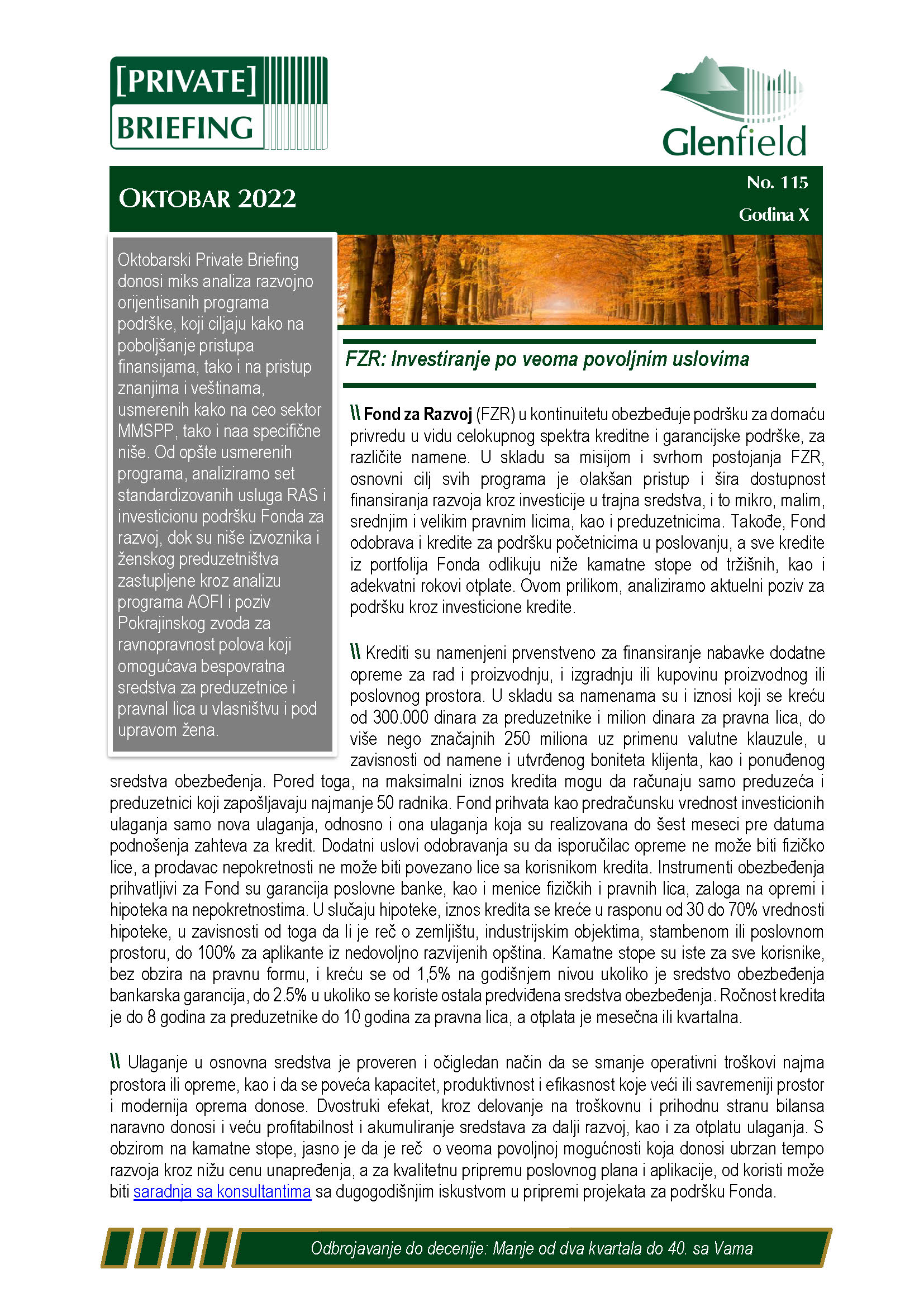
The August Private Briefing briefly pauses its hydration theme to analyse a flash wave of public calls launched by the Ministry of Economy, which together show an increasingly detailed segmentation of business support and will probably already be archived by the next issue. We open with the only instrument without a credit component, a full grant for businesses in underdeveloped municipalities and devastated areas. We then follow how the same group branches into two parallel directions of segmentation, programmes calibrated to the beneficiary profile, and programmes organised around the place in the production chain, premises, equipment and raw materials. The issue closes with an analysis of the Development Fund of Vojvodina’s tourism development loan, which, through a broad range of eligible purposes, connects professional tourism capacities with agricultural holdings that are only beginning to enter agritourism.
// The Ministry of Economy has launched a public call under the Programme for Balanced Economic Development of Serbia, “Equal Development Opportunities for Serbia’s Underdeveloped Regions”. It is a unique instrument within the Ministry’s broader August support package, operating without leverage, a credit component or own participation. The budget of 80 million dinars is intended for existing and newly established entrepreneurs, cooperatives and micro companies founded exclusively by individuals, operating in municipalities in the third and fourth development groups or in devastated areas. Unlike the seven parallel programmes of the Ministry and the Development Fund in the same package, with a total budget of 550 million dinars and open until 4 September, eligibility is neither demographic nor sectoral, but purely geographic, based on where the business operates. Applicants must not qualify as businesses in difficulty, and neither they nor related parties may have received more than 300.000 euros in state and de minimis aid over the current and previous two years.
Grants cover up to 100% of the purchase value stated in the pro forma invoice, including VAT, with no own participation as long as the investment remains within the upper limit. Support ranges from 300.000 to 800.000 dinars per beneficiary and covers new equipment, machinery, tools, computer equipment and software licences. Raw materials may account for up to 25%, and operating costs, including employee salaries except that of the founder, for up to 20% of the total investment. The supplier must be a credible manufacturer, importer or distributor unrelated to the beneficiary, while the equipment may not be delivered or partially paid for before the award decision. The investment must be completed within 12 months of disbursement, and activities may not begin before the contract is signed. Documentation differs according to the age of the business. Existing businesses must submit photographs of their premises, a fixed asset register as at 31 December 2025 and three invoices for products they supplied, while businesses younger than six months are exempt from these requirements. Security consists only of a blank business promissory note and a personal promissory note, without a mortgage or commercial bank guarantee. Beneficiaries also have access to free training and mentoring by accredited regional development agencies during preparation and implementation.
The value of this call for potential beneficiaries is clear, as it removes creditworthiness assessment, own participation and collateral, which, despite favourable conditions, make support harder to access for the most vulnerable segment of the economy. Under good development finance practice, however, a fully grant funded model also carries particular risks. The absence of own participation weakens beneficiary commitment and removes the natural filter own funding provides for the realism and sustainability of an investment idea. Models combining even a symbolic own contribution with subsidised interest or risk sharing with a lender, such as the lines we often analyse, generally balance accessibility better with the long-term sustainability and scalability of investment. The greatest practical value of this programme therefore remains as an entry point for businesses lacking the basis for any other form of financing, while even a symbolic contribution could further strengthen selectivity and the long term impact of the funds invested.
Ministry of Economy: Grants and Loans by Beneficiary Profile
// The August package of calls launched by the Ministry of Economy and the Development Fund (DF) continues the trend towards increasingly precise beneficiary segmentation, which has become progressively clearer through Private Briefing analyses. Three new programmes, “Young People Create Serbia”, providing financial support to young entrepreneurs, “Return and Create”, supporting business launch and development for returnees from abroad, and “Women Driving Serbia”, supporting women’s entrepreneurship in manufacturing, share the same mechanism, Ministry grants combined with an DF loan for the remaining investment value, through a single electronic application submitted via the Fund’s portal. The combined budget of the three parallel lines is 250 million dinars, while the difference between them lies not in their structure, but solely in who qualifies and how the intensity of support is determined.
All three programmes share the same DF credit component, with a repayment period of up to 60 months, a grace period of up to 12 months and an annual interest rate of 2,5% with a currency clause. Eligible purposes are also similar, covering equipment and machinery, delivery vehicles up to five years old, IT equipment and software, adaptation of business premises up to 1,5 million dinars and working capital up to 30% of the investment value. In all three cases, applications are submitted as a single request, accompanied by an DF model business plan, KYC questionnaire and prescribed statements, reducing the administrative burden to one documentation cycle. The differences lie in the definition of beneficiaries and the level of support.
“Young People Create Serbia” requires the founder, legal representative and manager to have been born in 1991 or later, while in companies with several founders young owners must hold at least 51% of equity. The programme budget is 80 million dinars, with grants of up to 40%, or 50% of the investment in municipalities in the third and fourth development groups. The total grant plus loan package ranges from 400.000 to 2,4 million dinars per application. “Return and Create”, with a budget of 70 million dinars, requires proof that the founder is a Serbian citizen who spent at least 24 continuous months predominantly abroad from 2016 onwards. Grants here increase through three levels, up to 40% of the investment, maximum 1,2 million dinars, up to 50%, maximum 1,5 million, where the returnee was born in 1991 or later or the business is based in a less developed municipality, and up to 60%, maximum 1,8 million, where both conditions are met.
The DF loan for the remaining investment may also reach 1,8 million dinars. “Women Driving Serbia”, with the largest budget in the group at 100 million dinars, requires a woman to own at least 50% of the business and simultaneously act as its legal representative in manufacturing. Grants cover up to 50% of the investment, maximum 1,5 million dinars, while the total package has the highest ceiling in the group, up to 3 million dinars per application, with the DF loan covering the remaining investment under the same repayment terms as the other two programmes. Alongside financing, all three lines include free training and advisory support from accredited regional development agencies, available before and during application preparation.
The differences between the programmes clearly show how the same instrument has been recalibrated three times to address different barriers faced by young entrepreneurs, returnees and women in the ownership structure of manufacturing businesses. Available budgets indicate their approximate reach. “Young People Create Serbia”, with 80 million dinars and a package of up to 2,4 million per application, has capacity for roughly thirty to one hundred beneficiaries, with a similar range for the other two programmes depending on average investment size. This suggests that, with strong demand, funds could be exhausted before the 4 September deadline. It remains open whether standard DF security requirements for larger loans, a mortgage or bank guarantee, will create an additional barrier for the very groups these programmes target, as none of the three calls provides collateral relief. This is particularly relevant for young entrepreneurs, whose short business history makes standard bank credit assessment more difficult, meaning that the grant and DF loan combination eases, but does not fully remove, this specific obstacle. Even so, the programmes clearly offer substantial benefits through low-cost credit and a high grant share, reducing financing costs and shortening the investment payback period and the time needed to generate stronger financial performance. This makes the package a sound support instrument and one worth recommending.
Ministry of Economy: Loans and Grants for Production Capacity and Raw Materials
// Alongside instruments aimed at the demographic profile of beneficiaries, the same August package of calls by the Ministry of Economy and the Development Fund brings four programmes organised according to a different logic of segmentation, not by who applies, but by what part of the production chain is being financed. The financial support programme for furniture production and wood processing, the production premises development programme “Building Space for Your Growth”, the financial support programme for food production from 100% domestic raw materials “Domestic Quality”, and the general financial support programme for the SME sector “Creators of Serbia” share the same structure, Ministry grants combined with an DF loan for the remaining investment value, with a total budget of 300 million dinars across the four parallel lines.
Basic eligibility conditions are almost identical in all four programmes. Potential beneficiaries are micro and small companies, cooperatives and entrepreneurs registered no later than the end of 2024, including newly established businesses registered from the beginning of that year. The programmes carry the standard DF credit component of up to 60 months, a grace period of up to one year and an annual interest rate of 2,5% with a currency clause, as well as the same documentation framework, a single application, an DF model business plan, KYC questionnaire and prescribed statements. The differences lie in the purpose of financing and the level of support.
The furniture and wood processing programme, with a budget of 50 million dinars, provides a grant of up to 40%, or 50% of the investment in municipalities in the third and fourth development groups. It finances production equipment, delivery vehicles up to five years old, permanent working capital up to 20% of the investment and adaptation of premises up to 700.000 dinars, with an DF loan of up to 1,2 million dinars for the remaining investment.
“Domestic Quality”, with a budget of 70 million dinars, adds a qualitative requirement that raw materials must be entirely of domestic origin. It offers the same grant range of up to 40% or 50%, the same 700.000-dinar limit for adaptation and the same DF loan ceiling of 1,2 million dinars.
“Building Space for Your Growth” stands out by financing construction, extension, reconstruction and adaptation of production and storage premises, with grants of up to 30%, or 40% in less developed municipalities, and the highest DF loan ceiling in the group, up to 3,5 million dinars, from a programme budget of 100 million dinars. “Creators of Serbia”, with a budget of 80 million dinars, is the only one of the four without a sectoral or demographic restriction. It provides grants of up to 50% of the investment, maximum 1 million dinars, and a total grant plus loan package ranging from 400.000 to 2 million dinars per application. Operating costs may account for up to 40% of total investment, the highest share of this type in the entire group.
Taken together with the three parallel programmes aimed at beneficiary profiles, these four lines show that the Ministry is applying segmentation in two directions at once, by who applies and by the place of financing within the production chain, premises, equipment and raw materials. The presence of “Creators of Serbia” as the only non-selective instrument among the seven calls shows that specialisation is not replacing universal support, but adding a more precise parallel layer. With seven instruments launched on the same day, this package therefore represents the most developed form of segmentation and specialisation in the group.
An additional advantage of all calls, alongside the clear value of low-cost borrowing and a high grant share, is the simple and direct application process, as well as the possibility of purchasing used vehicles and equipment, which considerably broadens the range of potential beneficiaries and investments. For users of more complex programmes such as “Building Space for Your Growth”, where investment normally requires construction documentation as well as a business plan aligned with the implementation and financing schedule, appropriate professional support can also be useful in preparing the application. The Glenfield team has long standing experience in structuring investment projects and preparing business plans for development loans, and our consultants are available for an initial eligibility assessment and support with documentation preparation.
DFV: Long Term Loans for Tourism Development
// The Development Fund of AP Vojvodina (DFV) has launched a call for long term tourism development loans, subsidised by the Provincial Secretariat for Economy and Tourism, with the aim of improving the level of equipment in tourism facilities, expanding the offer and increasing competitiveness and employment in the sector. The call is particularly focused on tourism activities characteristic of Vojvodina, including rural tourism such as hunting, fishing, wine and gastronomy, religious and cultural tourism, as well as village tourism, agritourism, small family hotels in rural areas, campsites, ethno villages and excursion sites. Eligible applicants include micro, small and medium sized companies and entrepreneurs registered for tourism and hospitality activities, as well as individuals under the age of 70 who are holders of active commercial family agricultural holdings, provided that both the beneficiary and the investment are located in AP Vojvodina.
Loans may be used for the construction, adaptation and equipping of accommodation and tourism service facilities, sports, recreational and rehabilitation capacities serving tourism, restoration of traditional rural households, purchase and adaptation of floating facilities and vehicles for tourist transport, as well as the design and production of souvenirs. The maximum amount is 20 million dinars for companies and entrepreneurs, and 10 million dinars for registered agricultural holdings, with a minimum loan of 300.000 dinars. For loans with a currency clause, the interest rate is 2% plus six-month EURIBOR, reduced by 1% where the loan is secured by a commercial bank guarantee. For dinar loans, the interest rate is linked to the NBS reference rate, with a margin of 0,50% for companies and entrepreneurs from municipalities in the third and fourth development groups,
and 0,80% for those in the first and second groups, as well as for registered agricultural holdings regardless of municipal development level. The Provincial Secretariat additionally subsidises regular interest during 2026. Own participation amounts to at least 20% of the estimated investment value, or 10% for investments in organic production. The repayment period is up to seven years, including a grace period of up to 24 months, and no application processing fee is charged. Security includes beneficiary promissory notes, while larger amounts also require a commercial bank guarantee or first ranking mortgage. For agricultural land, the appraised value must amount to at least 150% of the loan, and 200% for construction land and other real estate.
The practical value of this call lies in the fact that a single instrument, through a broad range of eligible purposes and two separate groups of beneficiaries, connects the entire rural tourism offer in Vojvodina, from professional accommodation capacities to agricultural holdings only beginning to diversify their income through agritourism. For registered agricultural holdings, this effectively means access to the same favourable cost of capital and subsidised interest as registered businesses, allowing investment in rural tourism to be financed under conditions generally unavailable outside specialised credit lines. The long repayment period and grace period also leave enough room for new tourism capacities to begin generating income before full loan repayment obligations take effect. Taken together, these conditions make the programme well worth recommending.
The current issue, as well as previous issues of Private Briefing in PDF format, are available here.
For any additional information or questions, feel free to contact us. Share your impressions, send us relevant news or let us know how your current projects are progressing.
Disclaimer: This report has been prepared and published under the authority of Glenfield Training and Consulting Doo and is intended for information purposes only. The information used has been obtained from sources considered reliable by Glenfield Training and Consulting Doo, but its accuracy and completeness are not guaranteed. No information or suggestion may be interpreted as an offer or solicitation to buy or sell. No part of this document may be reproduced without the written permission of Glenfield Training and Consulting.